
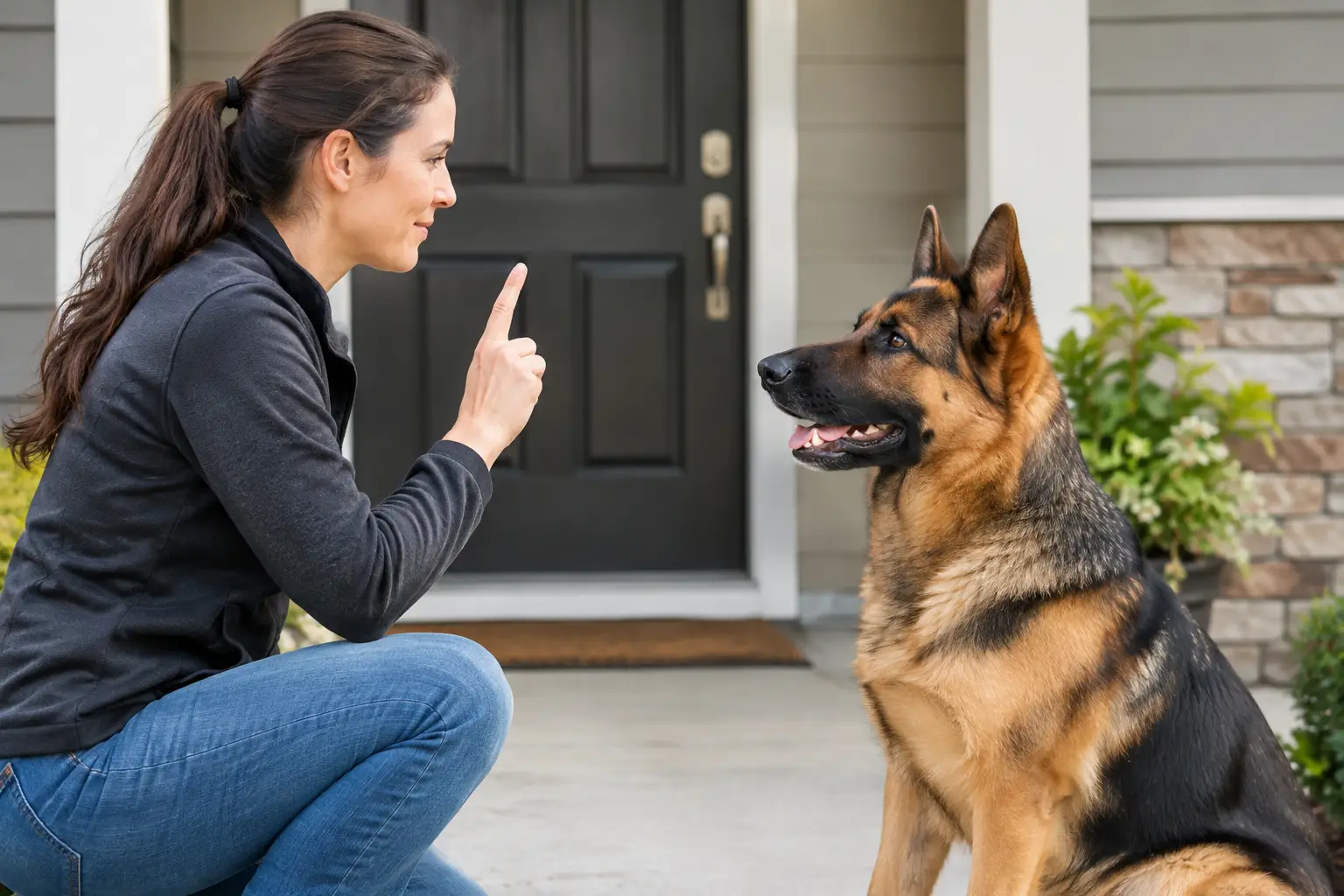
A protection dog is only as dependable as its control under pressure. Home security dog commands are not a collection of dramatic cues used when trouble has already arrived. They are the daily language that gives an owner command of the dog at the front door, around children, near guests, and during an actual security concern.
For a family security dog, obedience is the foundation of every serious protection capability. A dog that will not hold position, return immediately, or disengage cleanly is not a finished protection dog. It is a liability. The right commands create clarity for the dog and confidence for the handler.
Home Security Dog Commands Start With Control
The first commands a security-minded owner should value are not protection commands. They are the obedience standards that prevent confusion and establish reliable control in ordinary situations. A professionally trained dog must understand that the handler, not the environment, decides when to move, greet, alert, or settle.
Heel, Sit, Down, and Place
A precise heel keeps the dog with the handler while entering or leaving the property, meeting a visitor at the gate, or walking through a crowded public setting. The goal is not a casual walk. The dog should remain attentive, move with the handler, and avoid forging ahead to investigate every stimulus.
Sit and down provide immediate positional control. These commands are useful when a delivery driver approaches, a contractor enters the home, or family members need the dog out of a traffic area. A properly trained dog should hold the position until released, even when there is movement, noise, food, or unfamiliar people nearby.
Place is one of the most valuable commands for a home environment. The dog is sent to a defined bed, mat, platform, or other station and remains there until called or released. This is how a strong, observant guardian can be present without becoming a source of disorder during dinner, arrivals, maintenance visits, or children’s activities.
These commands should not be repeated five times. One clear cue should produce one clear response. If a dog only obeys after the third or fourth request, the handler does not have dependable control when stress rises.
The Alert Command and Controlled Deterrence
A serious security dog does not need to bark at every passing car. Constant barking dulls the dog’s judgment, unsettles the household, and makes it harder for the owner to recognize a meaningful change in behavior. The strongest family protection dogs are stable, environmentally confident, and able to distinguish normal activity from a reason for concern.
An alert or bark-on-command cue can be useful when an unknown person remains at a boundary, when the handler needs a visible deterrent, or when a dog must signal attention on command. The value is controlled presence. A confident dog that barks with purpose, then stops immediately when directed, sends a far clearer message than a dog that is frantic or indiscriminate.
The stop command matters as much as the alert. A dog must be able to become quiet and return to obedience without argument. This is where temperament and training meet. Nerve, drive, and confidence are necessary qualities in a capable security dog, but they must be balanced by clarity and control.
Recall Is the Non-Negotiable Safety Command
Every home security dog should have an immediate recall. Whether the cue is a verbal command, whistle, or both, the dog must return directly to the handler at speed and remain under control on arrival.
Recall is not only for off-leash exercise. It is the command that ends a potentially developing problem before it becomes more serious. A gate may be left open. A child may drop a leash. A neighbor’s dog may run onto the property. A guest may become uncomfortable with the dog’s attention. In each case, recall gives the handler a reliable answer.
Do not poison this command by calling the dog only when fun is over or correction is coming. Reward successful recall in appropriate training sessions, and do not test it in environments beyond the dog’s current level of proofing. A reliable recall is built through repetition, consistency, and escalating distractions, not hopeful shouting across a yard.
The Release Command Defines Accountability
A release command tells the dog that a task, position, or state of obedience has ended. It may release the dog from heel, down, place, a boundary position, or another assigned exercise. This cue prevents the dog from deciding for itself when work is over.
For trained protection dogs, the principle carries even greater weight. Any advanced protection exercise requires a clear out or disengagement command. The dog must release immediately and return to handler control when directed. This is not optional. It is a core measure of training quality, temperament, and responsible ownership.
Buyers should be cautious of any seller who focuses only on aggression, barking, or bite work while giving little attention to the out, recall, neutrality, and obedience around family life. Protection without a clean off switch is not protection. It is unmanaged risk.
Boundary and Perimeter Commands for the Home
Some owners benefit from a boundary command that teaches the dog to remain within a defined area or to respect a threshold. This may mean waiting inside when the front door opens, remaining behind a gate, or holding position at the edge of a driveway.
Boundary work should never be used as a substitute for physical security. Gates, fencing, locks, cameras, and lighting remain essential. Even an elite dog can be distracted, injured, removed, or exposed to an unsafe situation. The dog is a powerful layer of protection and deterrence, not the entire security plan.
A perimeter check can also be useful for qualified handlers and trained dogs, but it must be introduced and maintained by a professional. Sending an untrained or unstable dog to investigate the property creates risk for the dog, household members, and anyone who may be lawfully present. The dog must understand the assignment, remain responsive, and return on command.
How Commands Should Be Practiced at Home
Daily work does not need to be long. Five to ten focused minutes, built into normal routines, will do more for reliability than occasional marathon sessions. Ask for a heel from the car to the front door. Use place while packages are brought in. Practice down-stay while the family moves around the room. Call the dog from the yard before every meal or play session.
The standard should remain consistent across handlers. If one family member allows the dog to break place, pull on leash, or ignore recall while another demands precision, the dog receives mixed information. Children should only give commands appropriate to their age and ability, and adults must supervise all interactions with a working protection dog.
Avoid turning every repetition into confrontation. Clear handling, fair correction when needed, and meaningful reward build a dog that works with confidence. The goal is not to suppress the dog’s character. It is to channel its natural guardian instincts through disciplined obedience.
When Professional Handling Is Required
Advanced protection commands should not be improvised from online videos or taught by provoking the dog at home. Civil aggression, threat recognition, engagement, and disengagement involve legal, behavioral, and safety considerations that demand experienced professional training.
A finished family protection dog should arrive with more than impressive demonstrations. The owner needs a proper transfer process that covers handling mechanics, command vocabulary, household rules, leash control, introductions, travel, and realistic expectations. At EurosportK9, the standard is a dog with the temperament and obedience to live as a stable companion while retaining serious, functional protective ability.
The best command is the one your dog performs correctly the first time, in the place where it matters. Build that standard every day, protect it with consistent handling, and let professional training carry the weight where true security work begins.
continue reading
Related Posts

Estate guardian placement pairs a proven protection dog with your property, family, and routine for controlled, dependable security every day at home.
Learn how to prepare children for guardian dogs with clear rules, supervised routines, and professional guidance for a secure, respectful home every day.
This executive security dog guide explains selection, training, handling, and placement standards for dependable personal and family protection at home.
